

Scientific Papers
Peer-reviewed articles produced within the HELIOS project. Each paper advances the science behind white-emitting organic lighting systems and feeds directly into the project's research and innovation objectives.
6 peer-reviewed articles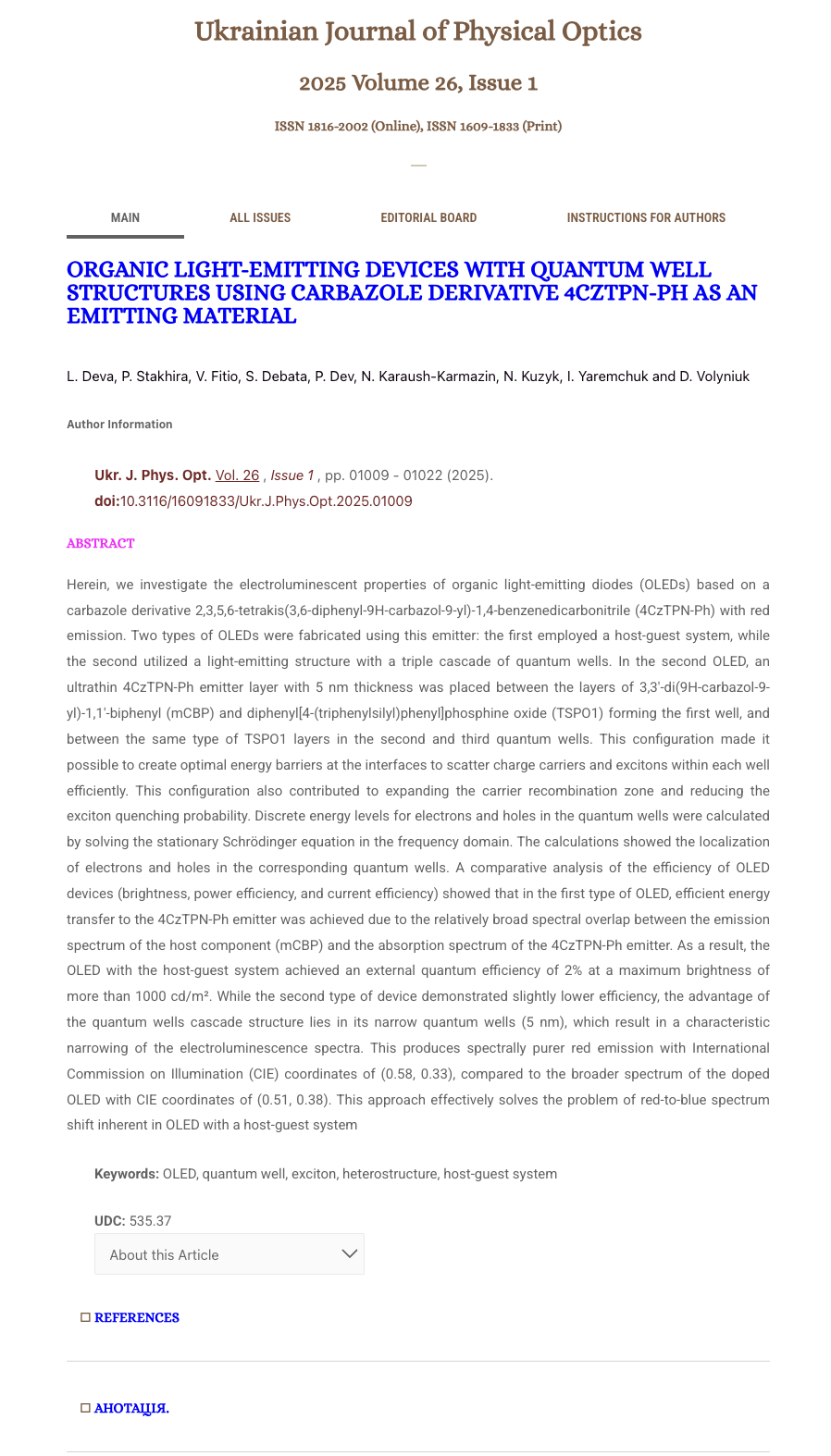
Organic Light-Emitting Devices with Quantum Well Structures Using Carbazole Derivative 4CzTPN-Ph as an Emitting Material
Overview
The team studied the electroluminescent behaviour of red-emitting OLEDs based on the carbazole derivative 4CzTPN-Ph. They built two device types with the same emitter: a conventional host–guest device, and a light-emitting structure with a triple cascade of quantum wells, where an ultrathin 5 nm emitter layer sits between mCBP and TSPO1 barriers. The host–guest device reached about 2% external quantum efficiency at a brightness above 1000 cd/m², while the quantum-well cascade produced noticeably narrower electroluminescence spectra thanks to the 5 nm wells.
Impact on the project
This is one of the first experimental OLED demonstrations from the HELIOS twinning team, establishing the quantum-well approach as a route to control emission colour and spectral width in white-emitting devices — the core aim of the project. It builds Lviv Polytechnic's device-fabrication capacity and gives HELIOS a working reference platform for tuning emitter layers.
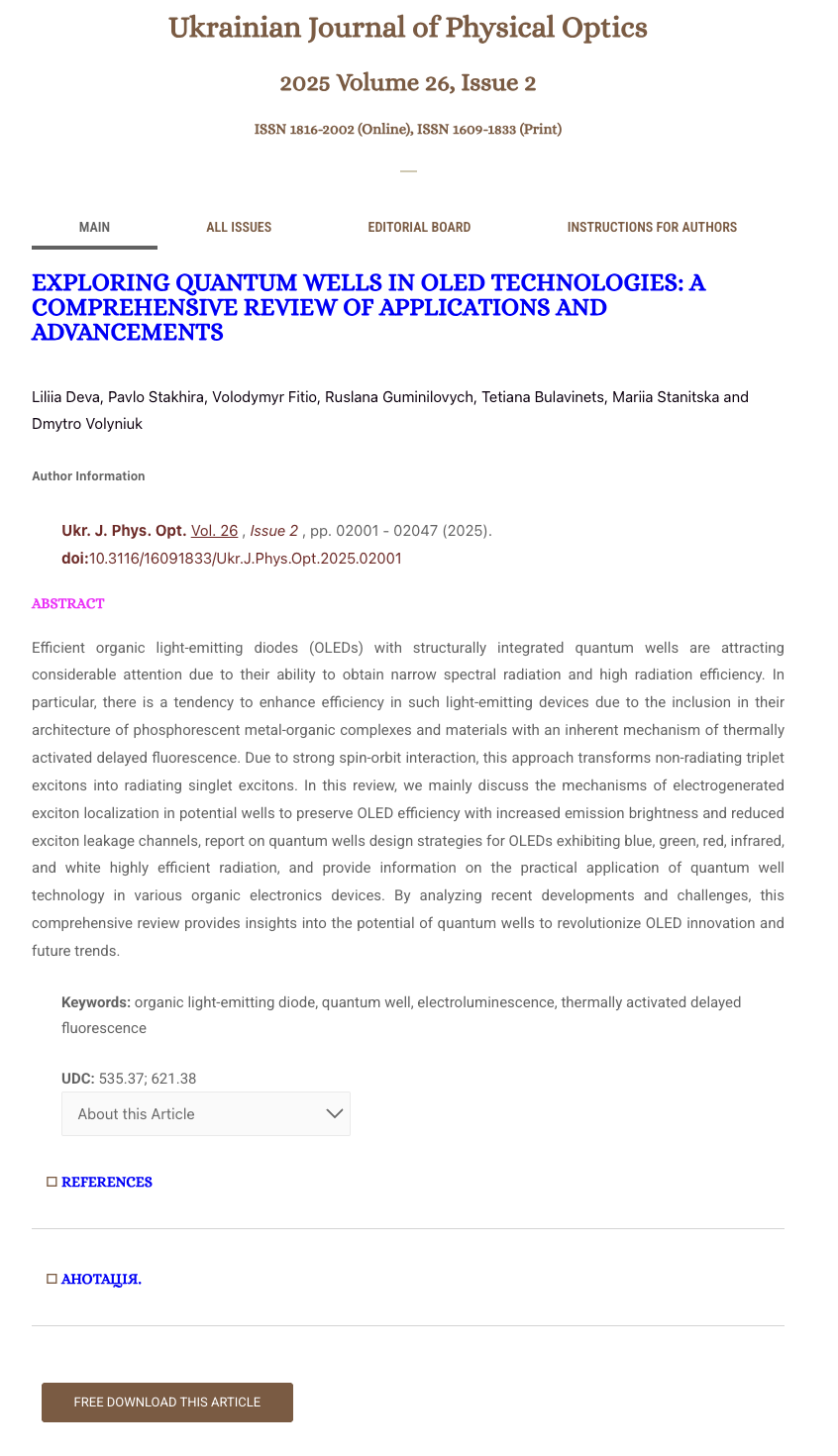
Exploring Quantum Wells in OLED Technologies: A Comprehensive Review of Applications and Advancements
Overview
An extensive review (over 45 pages) mapping how quantum-well structures are used across OLED technology. It surveys device architectures, energy-level engineering, host and barrier materials, TADF emitters and the role of well width in confining charge carriers and excitons, then sets out the current state of the art and open challenges for the field.
Impact on the project
This review consolidates the scientific foundation HELIOS builds on. It positions the project's experimental work within the wider OLED landscape, serves as a shared reference for the consortium and twinning partners, and signals Lviv Polytechnic's growing authority in quantum-well OLED research — strengthening the project's dissemination and networking objectives.
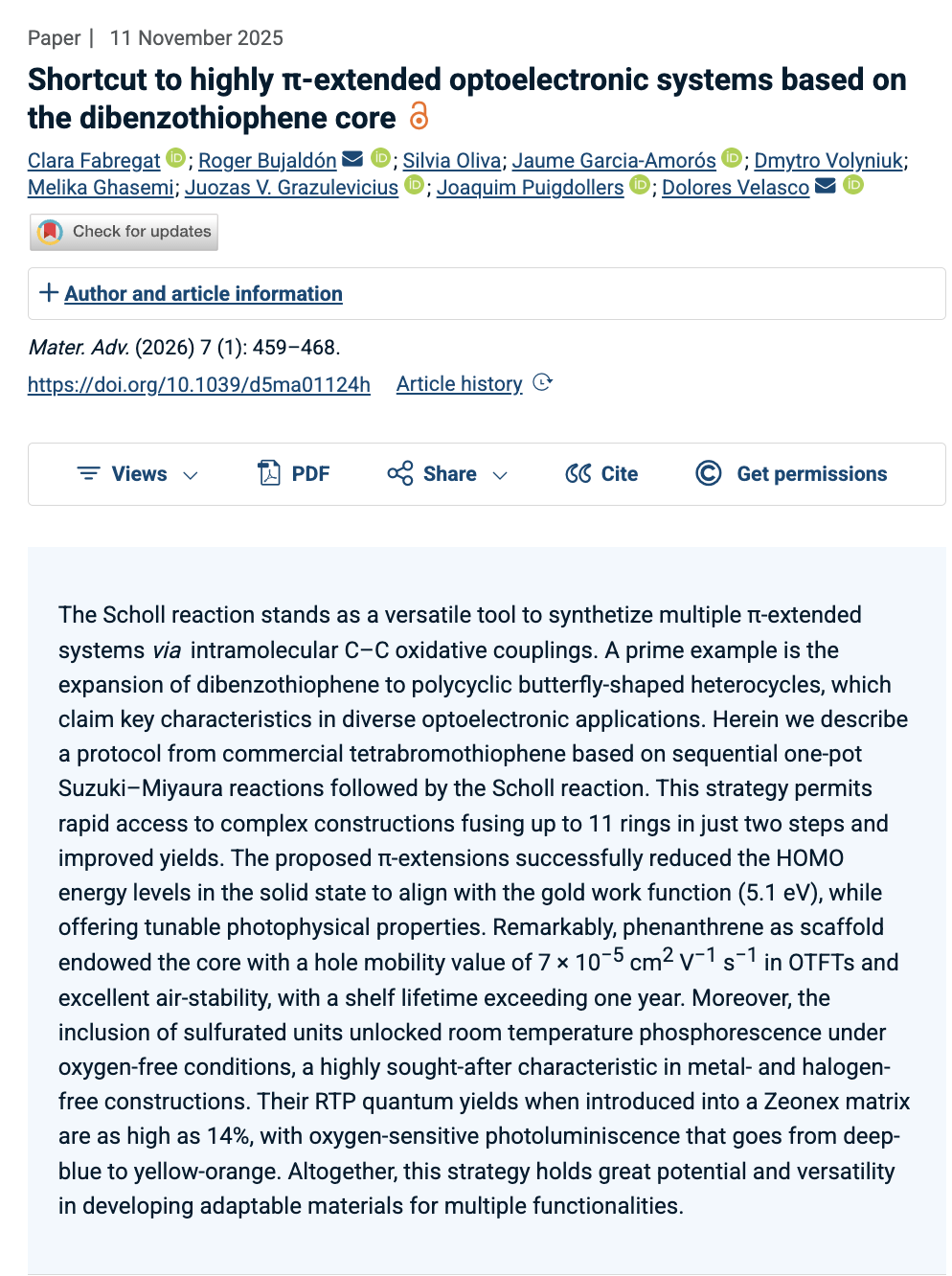
Shortcut to Highly π-Extended Optoelectronic Systems Based on the Dibenzothiophene Core
Overview
The authors present a fast synthetic route to highly π-extended, butterfly-shaped molecules built around the dibenzothiophene core. Starting from commercial tetrabromothiophene, sequential one-pot Suzuki–Miyaura couplings followed by a Scholl reaction fuse up to 11 rings in just two steps, with improved yields. The resulting materials show properties ranging from p-type semiconductivity to molecular sensing.
Impact on the project
A concrete outcome of HELIOS international collaboration, linking the Kaunas twinning partner (Volyniuk, Grazulevicius) with the University of Barcelona. It expands the project's toolbox of organic semiconductor building blocks and demonstrates efficient synthesis of multifunctional π-extended materials relevant to the optoelectronic devices at the heart of HELIOS.
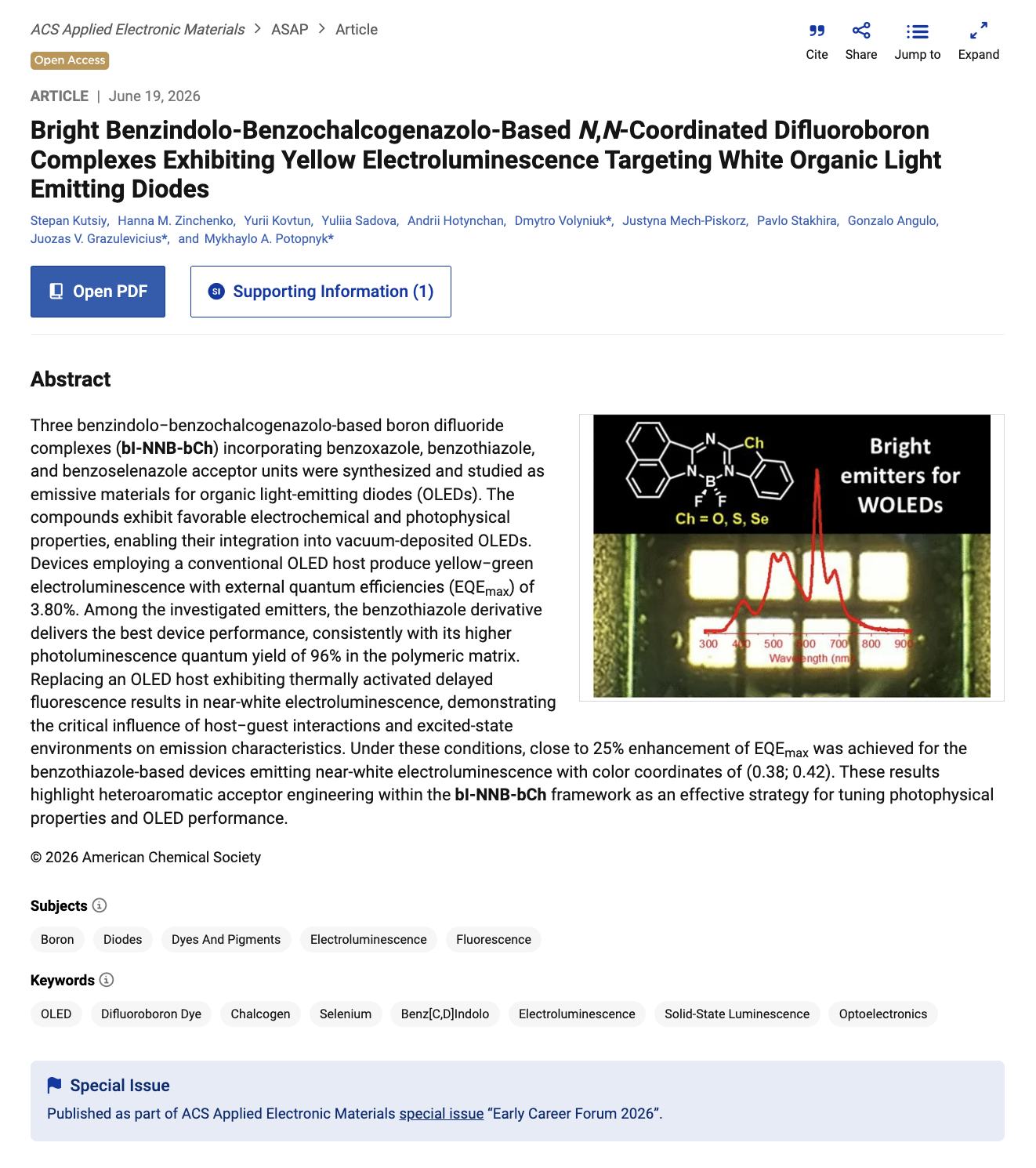
Bright Benzindolo-Benzochalcogenazolo-Based N,N-Coordinated Difluoroboron Complexes Exhibiting Yellow Electroluminescence Targeting White OLEDs
Overview
The study designs bright N,N-coordinated difluoroboron complexes based on a benzindolo-benzochalcogenazolo framework. These emitters produce strong yellow electroluminescence and are engineered specifically as a colour component for white organic light-emitting diodes, with the molecular design tuned to deliver efficient, stable emission.
Impact on the project
Directly on-target for HELIOS. White light is commonly built by combining a blue and a yellow emitter, so a bright, dedicated yellow emitter is a key ingredient for the white-emitting organic lighting systems the project is named after. The work also embodies the HELIOS collaboration model, joining Lviv Polytechnic, Kaunas and the Polish Academy of Sciences.
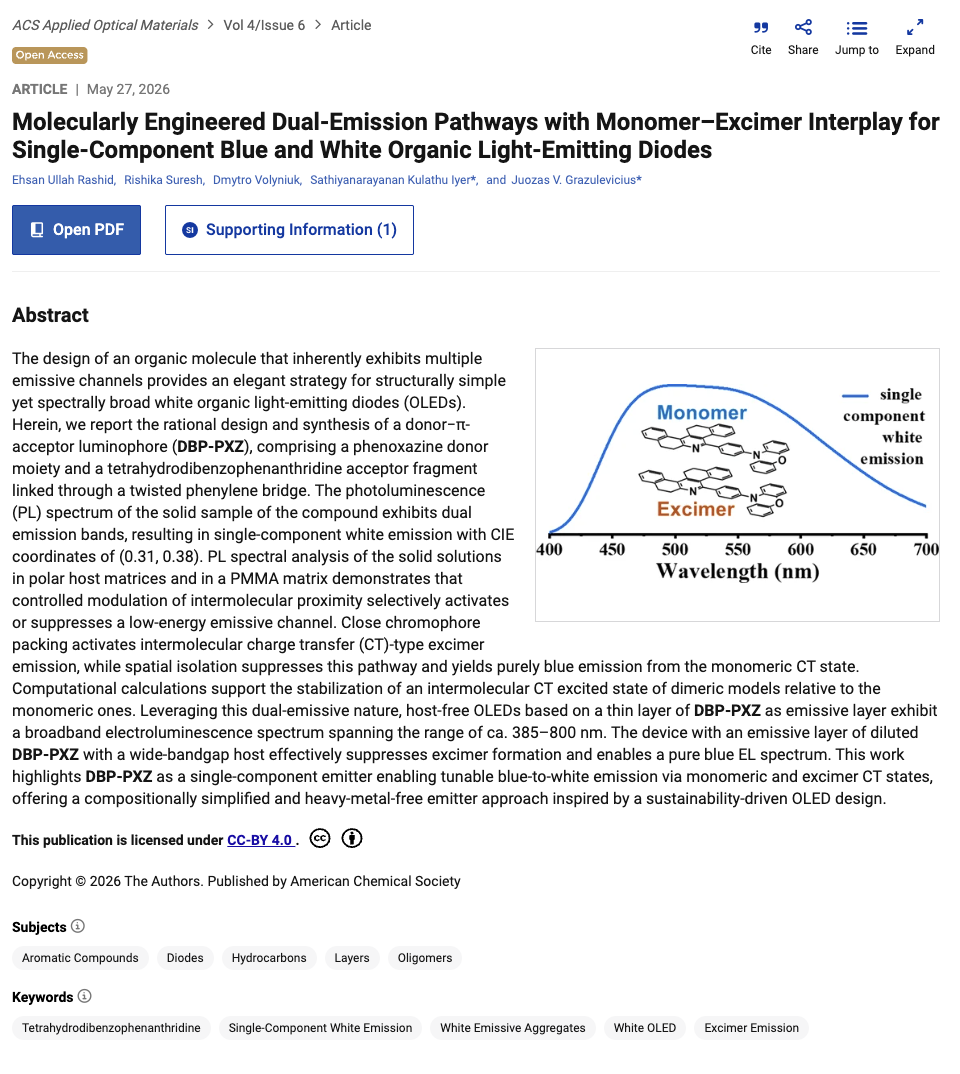
Molecularly Engineered Dual-Emission Pathways with Monomer–Excimer Interplay for Single-Component Blue and White OLEDs
Overview
The paper reports a donor–π–acceptor luminophore (DBP-PXZ) that emits from two distinct excited states at once. Close molecular packing switches on a low-energy excimer channel, while spatial isolation suppresses it and leaves pure blue monomer emission. Controlling that packing lets a single molecule produce either blue light or balanced single-component white light with CIE coordinates near (0.31, 0.38).
Impact on the project
A elegant route straight to the HELIOS goal: white emission from one simple material instead of a complex multi-emitter stack. Single-component white OLEDs mean simpler, cheaper and more reproducible devices, advancing the project's vision of sustainable, efficient white organic lighting.
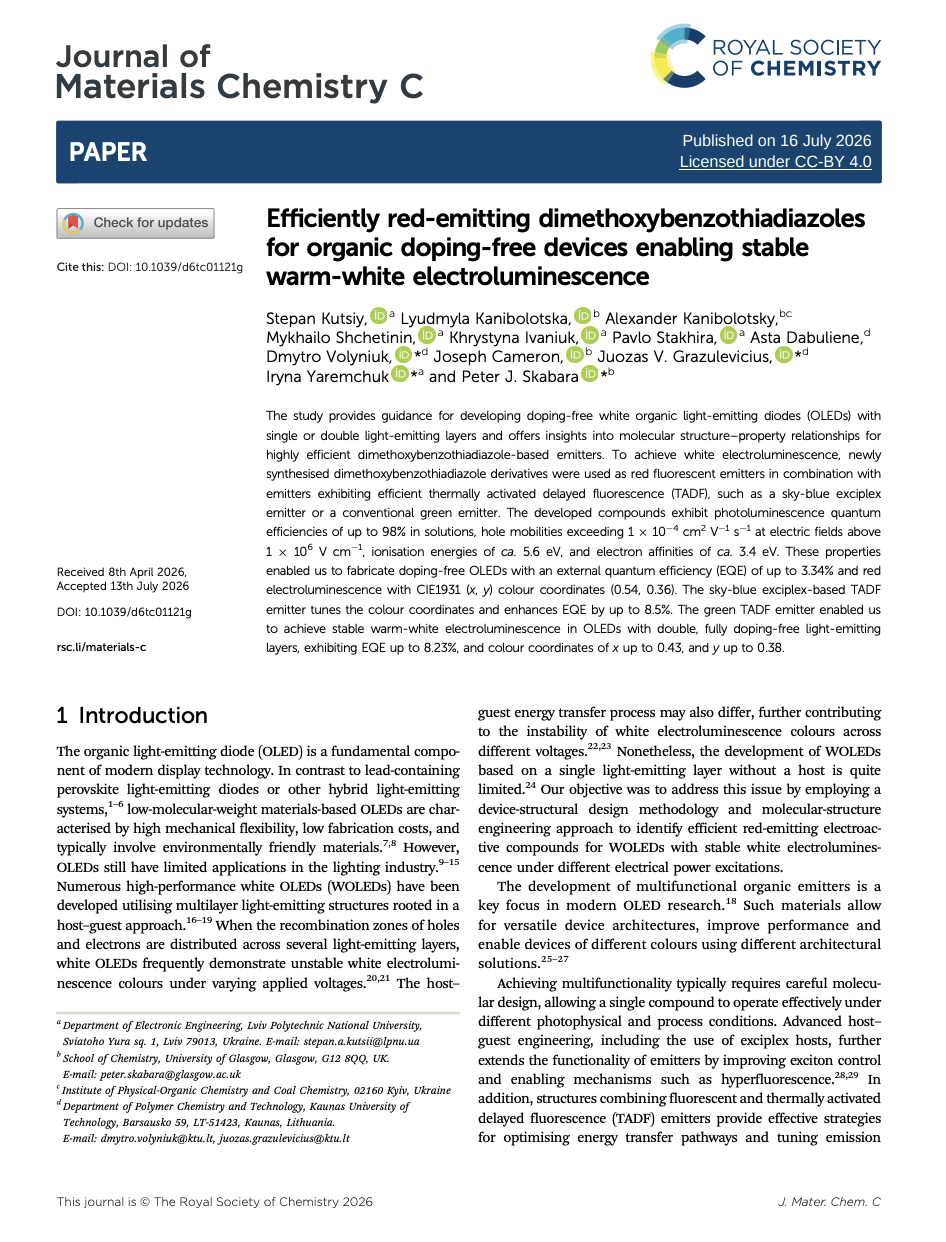
Efficiently red-emitting dimethoxybenzothiadiazoles for organic doping-free devices enabling stable warm-white electroluminescence
Overview
Newly synthesised dimethoxybenzothiadiazole derivatives are used as red fluorescent emitters in combination with TADF emitters — a sky-blue exciplex or a conventional green emitter. The compounds reach photoluminescence quantum efficiencies of up to 98% in solution, hole mobilities above 1 × 10⁻⁴ cm² V⁻¹ s⁻¹, ionisation energies of ca. 5.6 eV and electron affinities of ca. 3.4 eV. This enabled doping-free OLEDs with external quantum efficiency up to 3.34% and red electroluminescence at CIE1931 (0.54, 0.36); the sky-blue exciplex TADF emitter tunes the colour coordinates and lifts EQE to 8.5%, while the green TADF emitter delivers stable warm-white electroluminescence in fully doping-free double-emitting-layer devices with EQE up to 8.23% and coordinates up to x = 0.43, y = 0.38.
Impact on the project
The clearest HELIOS result so far on the project's headline objective: stable warm-white light from OLEDs that need no host–guest doping at all. Removing the doping step makes devices simpler, cheaper and far more reproducible to manufacture, while the paper's structure–property guidance gives the consortium a design rulebook for future red emitters. It also widens the project's collaboration network, bringing the University of Glasgow together with Lviv Polytechnic, Kaunas University of Technology and the Institute of Physical-Organic Chemistry and Coal Chemistry in Kyiv. Published open access under CC-BY 4.0 in a leading RSC materials journal, it is freely available to the whole research community.
